


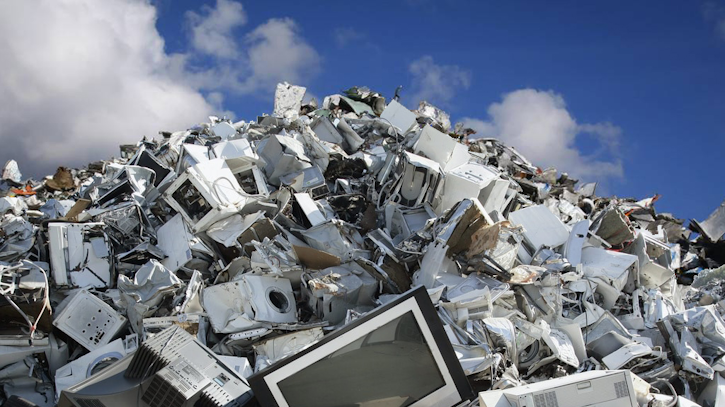
The value of electronic waste produced in 2023 was estimated at $51 billion. Only 17% of the electronic waste produced in 2023 was recycled. The impact on climate change and public health is worrying researchers.
Phones, computers, refrigerators, and printers: these electronic products, now essential to our daily lives, become a scourge once thrown in the trash. According to a UN report cited in The Conversation, the world’s population generated 58.6 million tons of waste electrical and electronic equipment (WEEE) in 2023, the equivalent of 375 cruise ships.
Of this mountain of waste, which increased by 33% compared to 2014, only 17.4% of the equipment was recycled, sometimes using dumpster rentals according to Cincinnati Dumpster Rental Whiz. A ridiculously small percentage, according to the researchers behind the report.
In detail, Asia tops the list of continents producing the most waste, with 24.9 million tons of WEEE (Waste Electrical and Electronic Equipment). It is followed by the Americas (13.1 tons), Europe (12), Africa (2.9), and Oceania (0.7). France alone produced 1.362 million tons of waste, an average of 21 kilos per person, a figure well above the global average of 7.3 kilos. However, Europe can boast a recycling rate of 42.5% of its WEEE, while its neighbors do not exceed 12%.
Among the continents, Europe stands out as a top performer in terms of recycling.
Nearly 100 million tons of CO2
When not collected, this equipment accumulates in the environment, causing considerable pollution. Discarded heat exchange components, such as those found in refrigerators and air conditioners, slowly release greenhouse gases, thus contributing to global warming. Approximately 98 million tons of CO2 escape from scrap yards each year, representing 0.3% of global energy sector emissions, the report states.
This waste also poses a serious health threat to residents who live or work near these landfills. Exposure to mercury, in particular, present in computer monitors and fluorescent lighting, can cause brain damage.
A Slow Awareness about Waste
Yet WEEE represents a veritable untapped treasure. Many of these components contain precious metals, such as gold, silver, copper, and platinum. UN researchers have estimated (approximately) the value of all these components for 2023 at $51 billion, an amount almost equal to Serbia’s GDP. Due to the low recycling rate, only $9.5 billion worth of e-waste could be recovered.
Fortunately, as the report points out, the world is slowly waking up to the scale of the problem.
At the end of 2023, 78 countries, representing 72% of the world’s population, had a WEEE (Waste Electrical and Electronic Equipment) management policy or were about to implement one, a 5% increase compared to 2017. The remarkable growth of the refurbished device market, estimated at $90 billion, is one of the positive signs.
The researchers will continue to monitor the evolution of electronic waste worldwide to support the creation of a circular economy and more sustainable societies. This may encourage people to repair or recycle their electronic devices, rather than discarding them without considering the consequences. Also governments are gradually becoming more involved in e-waste management within their waste management efforts.